The 5 Types of Crypto Trading Bots and What Can Go Wrong?
A crypto trading bot is a program that buys and sells cryptocurrency for you, following rules you set in advance. It does not predict prices — it executes a plan, including a bad one.
If you are new to the idea, our Blog's beginner's guide to crypto trading bots explains how to choose one, set it up, and connect it to an exchange. This guide goes one step further: it explains the main types of bots, how each one works, and the risks each one carries.
Learn About The Main Types of Trading Bots
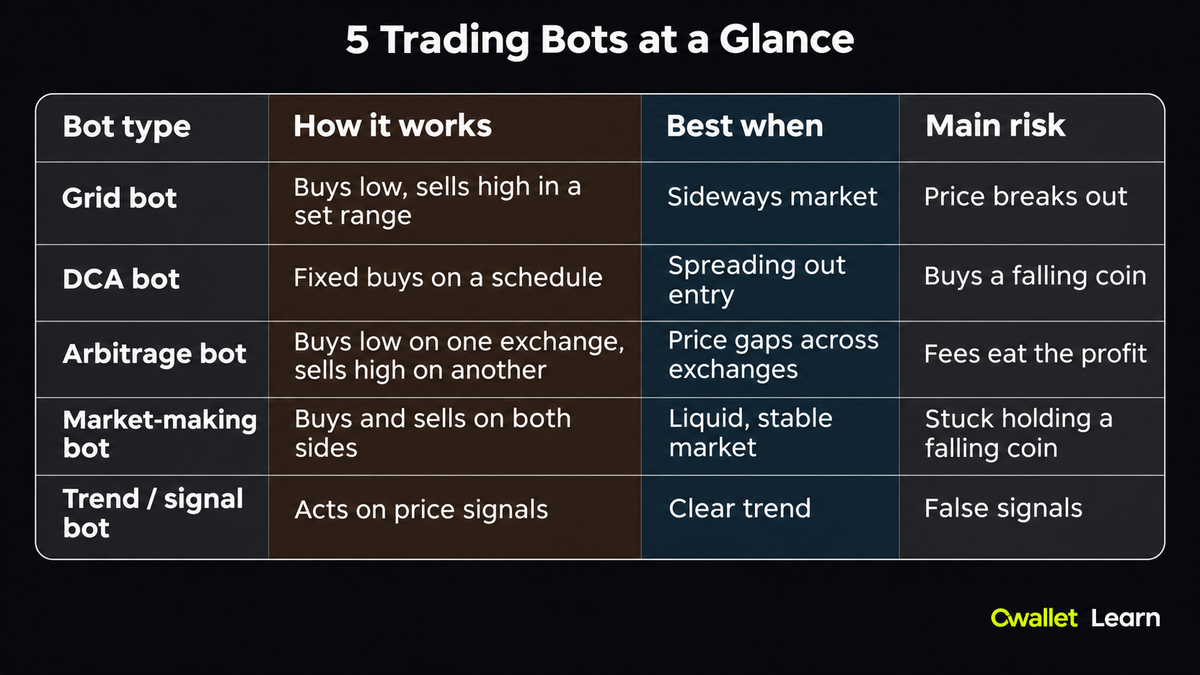
Most bots belong to one of a handful of strategy families. Here is what each one does, when it works best, and what can go wrong.
Grid bots place a series of buy and sell orders inside a price range you choose. Each time the price drops a set amount, the bot buys; each time it rises a set amount, it sells. They work best when the price moves sideways inside the range. The main risk is a breakout: if the price leaves the range, the bot keeps buying a falling coin or stops trading entirely.
DCA bots automate dollar-cost averaging (DCA), buying a fixed amount on a schedule or after a set price drop, regardless of short-term moves. They spread out the entry price over time instead of betting everything on a single moment. The main risk is that DCA does not protect you if the coin keeps falling — the bot keeps buying, and the losses add up.
Arbitrage bots look for price differences for the same coin across exchanges, buying where it is cheaper and selling where it is more expensive. The gaps are usually small and close fast, so these bots depend on speed. The main risks are fees eating the small profit, and the price moving before both sides of the trade complete.
Market-making bots place buy and sell orders on both sides of the market at the same time, aiming to profit from the small spread between the two prices. They work on the same idea as automated market makers (AMMs), which keep a trading pair liquid by always offering a price. The main risk is a sharp one-sided move: the bot ends up holding a large position in a falling coin.
Trend and signal bots watch for a signal — a moving-average crossover, a volume spike, a breakout — and act when it appears. They follow momentum, buying when the trend points up and selling when it turns. The main risk is a false signal: the bot buys into a brief spike that reverses immediately, a pattern known as a whipsaw.
Know the Differences Between Rule-Based Bots vs AI Bots
There are two broad ways a bot can decide what to do. Rule-based bots follow fixed instructions built around market indicators such as moving averages and the relative strength index (RSI), a tool that measures whether a coin looks overbought or oversold. They are predictable and easy to test, but they cannot adapt when the market changes in a way their rules did not anticipate.
AI and machine-learning bots are a newer development: they learn from historical and live market data and adjust their behaviour based on what they observe, sometimes reading news and social sentiment as well. The difference is adaptability, not accuracy — an AI bot can still be wrong.
Learn About The Risks and Limits
A bot is not a source of guaranteed profit.In January 2024, the US Commodity Futures Trading Commission published a customer advisory titled “AI Won’t Turn Trading Bots into Money Machines,” warning that no bot can promise returns. A grid bot does not know whether the price will stay in its range; a DCA bot does not know whether the coin it keeps buying will recover.
Each one simply reacts to price with pre-set orders.
There are other risks. A bot only follows the rules you gave it, so a badly designed rule produces bad trades, automatically and repeatedly. Connecting a bot through an API means trusting a third party with access to your exchange account; if that platform is hacked or dishonest, your funds are at risk. And bots do not remove market risk — if the market falls, a bot holding a losing position loses money just as a human would.
Fees also add up: every order a bot places pays the exchange's normal trading fee, and a bot that trades very often can generate a large fee bill.One more practical limit: bots need monitoring. Markets change, and a strategy that worked last month can stop working. A bot is a tool you manage, not a machine you switch on and forget.
What Do Bots Differ From Manual Trading
Manual trading gives you full judgment on every order, but it is limited by your time, your attention, and your emotions. A bot gives you consistency and speed, but no judgment of its own. Neither one makes a bad strategy good. The choice is not really bot versus human — it is whether you have a plan worth automating, and whether you are willing to watch the bot that runs it.
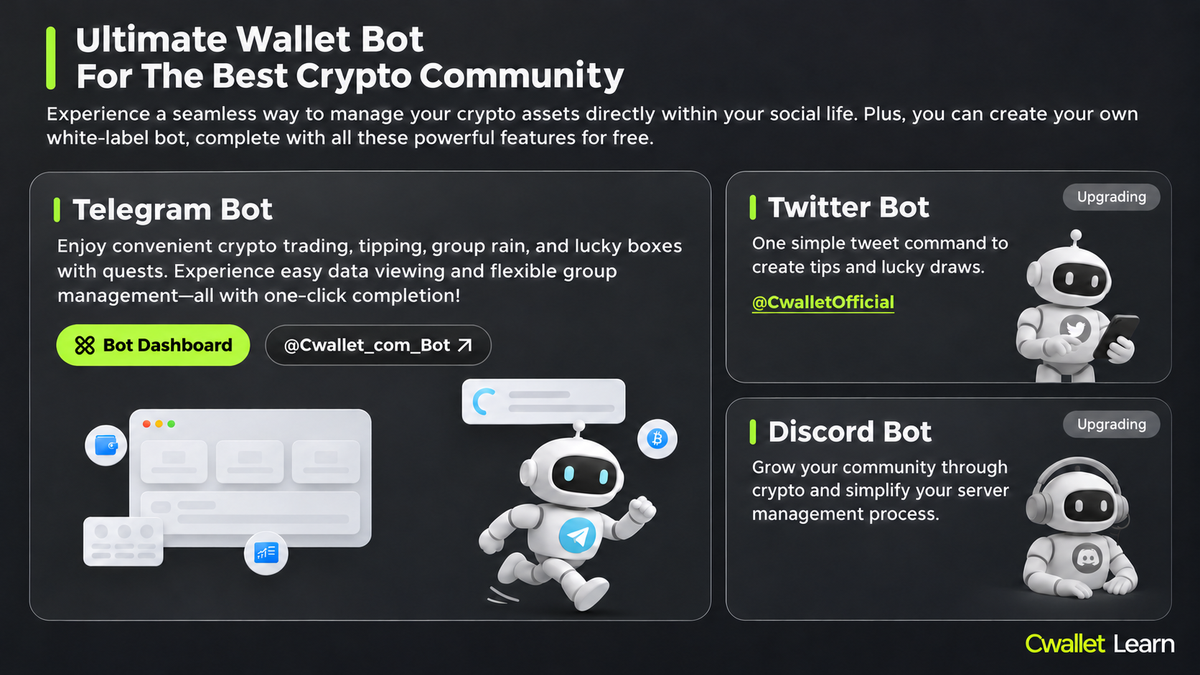
If you want to try a bot without setting up API keys, Cwallet's Telegram bot is a low-friction way to start: you can trade and use Cwallet features right inside Telegram.
Our Blog goes deeper on the practical side: are crypto trading bots profitable and a beginner's guide to crypto trading bots.

Common Questions About Crypto Trading Bots
Are crypto trading bots profitable?
They can be, but only if the strategy behind them is sound and the market cooperates. No bot guarantees profit, and a bot running a bad strategy loses money faster than a human would, because it never stops to reconsider.
Do I need to know how to code to use a trading bot?
Usually not. Most exchange bots and bot platforms are configured through forms: you pick a trading pair, a strategy, and parameters such as a price range or order size. Coding helps only if you want to build a custom strategy from scratch.
Can a trading bot lose all my money?
It can lose a large part of it if it keeps buying a falling coin or if the platform holding your API key is compromised. It is unlikely to lose everything in one trade, because bots normally trade in small slices, but repeated losses add up. Limiting the funds a bot can access is the basic safeguard.
Are trading bots legal?
In most countries and regions, using a trading bot is legal, but it depends on where you live and which exchange you use. Some exchanges restrict or ban certain bot activity, so check the exchange's rules before connecting one.
Disclaimer: The information in this article is for educational purposes only and does not constitute financial advice, investment advice, trading advice, or any other sort of advice. High-leverage trading involves substantial risk of loss and is not suitable for every investor. Please perform your own due diligence and never invest money that you cannot afford to lose.