What Is an AMM in Crypto? How Automated Market Makers Work
Ever wondered how a DEX can quote a price when no buyer is waiting on the other side? An automated market maker uses liquidity pools and smart-contract math to make that swap possible.
This guide explains the model, its risks, and how Cwallet users may encounter it in everyday token swaps.
What Is an AMM in Crypto?
An automated market maker AMM is a smart-contract system that lets users swap crypto without a traditional order book. Instead of matching buyers with sellers, it uses token reserves in a liquidity pool and code to calculate prices.
In simple terms, users trade against a pool, while the smart contract updates its balances after each swap. This is the core idea behind AMM crypto explained for beginners.
How Does an AMM Work?
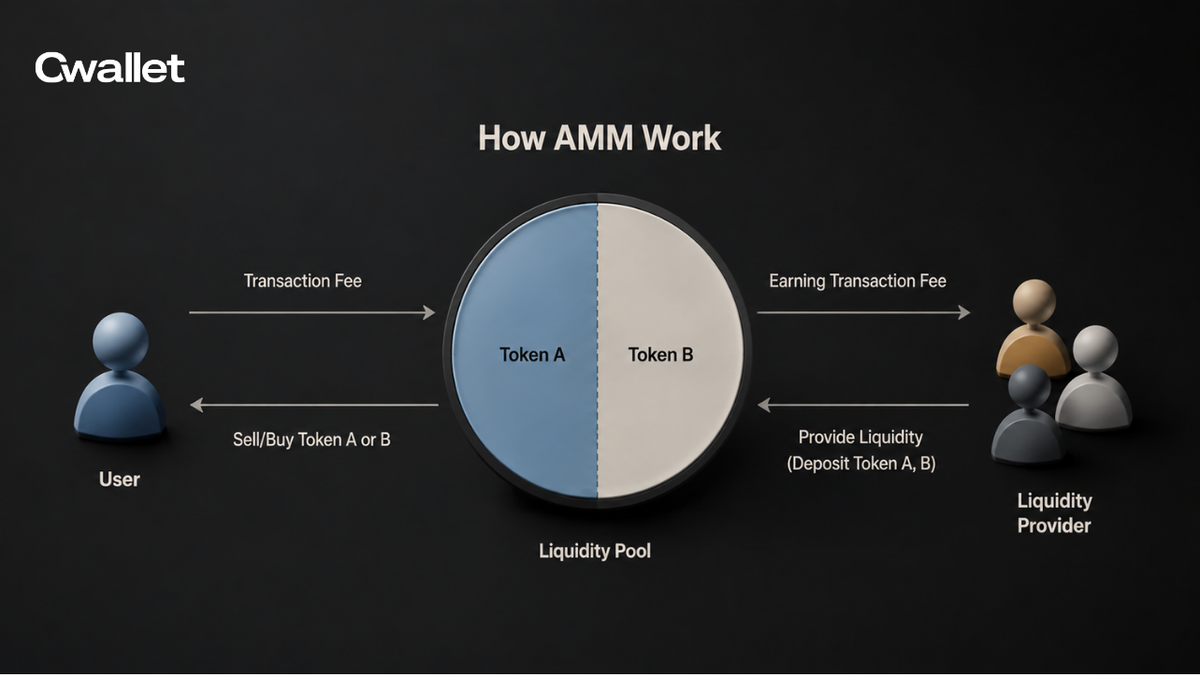
An AMM liquidity pool usually contains two tokens, such as ETH and USDC. Liquidity providers deposit both assets, and traders swap one token for the other according to the pool’s pricing formula. In a typical swap:
- You deposit one token into the pool.
- The smart contract sends the other token to you.
- The pool updates its reserves and exchange rate.
Deeper pools can generally handle larger trades with less price movement.
How Does an AMM Compare with an Order Book?
The automated market maker vs order book difference is how trades are matched:
- Order book: buyers and sellers post bids and asks until their prices meet.
- AMM: traders swap against a liquidity pool priced by a formula.
Order books offer precise price control and advanced orders; AMMs offer open, continuous on-chain swaps. Learn more about order books.
What Is the Constant Product Formula?
One well-known AMM design uses the constant product market maker formula:
$$x \times y = k$$
Here, $$$$ and $$$$ represent the quantities of the two tokens in the pool, while $$$$ is their constant product. If a trader removes some ETH from an ETH-USDC pool, the trader must add enough USDC to keep the product balanced. The ratio between the reserves changes, which changes the price.
For example, a pool with 10 ETH and 20,000 USDC has a constant product of 200,000. If a trader buys 1 ETH, the pool needs about 22,222.22 USDC to preserve that product. The trader adds about 2,222.22 USDC, and the reserve change creates price impact.
Can Liquidity Providers Earn Passive Income?
Liquidity providers normally receive a share of trading fees, which creates the possibility of crypto liquidity pool passive income. Returns are not guaranteed and depend on volume, fees, pool size, and token prices. LPs also face impermanent loss risk in DeFi: if the deposited tokens move apart in price, the position may be worth less than simply holding them separately.
What Are Slippage and Price Impact?
DEX slippage and price impact describe two execution risks. Slippage is the difference between the expected and final price; price impact is the effect of your own trade on the pool’s rate. Large trades in small pools usually create more of both. Before confirming a swap, check:
- The quoted amount and minimum received
- The expected price impact
- The network fee
These details help you judge whether the trade fits your intended cost.
How Can Cwallet Users Apply This Knowledge?
Cwallet users may encounter AMMs when swapping tokens.
Before confirming a swap, review the quoted rate, minimum received, price impact, and network fee. Cwallet’s all-in-one wallet brings asset management and trading tools together, making it easier to move from learning about AMMs to checking a real transaction.
If you explore DeFi liquidity opportunities, also compare the pool’s fees and depth with the risk of token-price divergence.

❓Common Questions About AMMs
Is an AMM the same as a DEX?+
No. An AMM is a pricing and liquidity model; a DEX is the broader decentralized trading platform. Many DEXs use AMMs, but some use order books.
How do liquidity providers earn?+
They usually receive a share of trading fees, but returns depend on volume, fee rates, pool size, and token prices.
Can you lose money in an AMM?+
Yes. Traders face slippage and price impact, while LPs may face impermanent loss and smart-contract risk.
Conclusion
AMMs use liquidity pools and mathematical formulas to enable on-chain swaps without traditional order books. They offer open access, but slippage, price impact, smart-contract risk, and impermanent loss remain.
For Cwallet users, understanding these mechanics makes it easier to review swap details and use an all-in-one Web3 wallet with more confidence.
Disclaimer: The information in this article is for educational purposes only and does not constitute financial advice, investment advice, trading advice, or any other sort of advice. High-leverage trading involves substantial risk of loss and is not suitable for every investor. Please perform your own due diligence and never invest money that you cannot afford to lose.