Binance Hack: What Happened, What Followed, and What It Means for Your Crypto
About $6.3 billion left Binance's hot wallets in around 20 minutes on October 29, 2026, in the largest crypto theft on record — and Binance says its users will not lose money, because the company is covering the loss of its own funds.
What Happened on October 29?
Short version first: the money did not leave because someone guessed a password. It left because the attackers reached the internal system that signs transactions, and made Binance's own wallets sign transfers to address the attackers controlled.
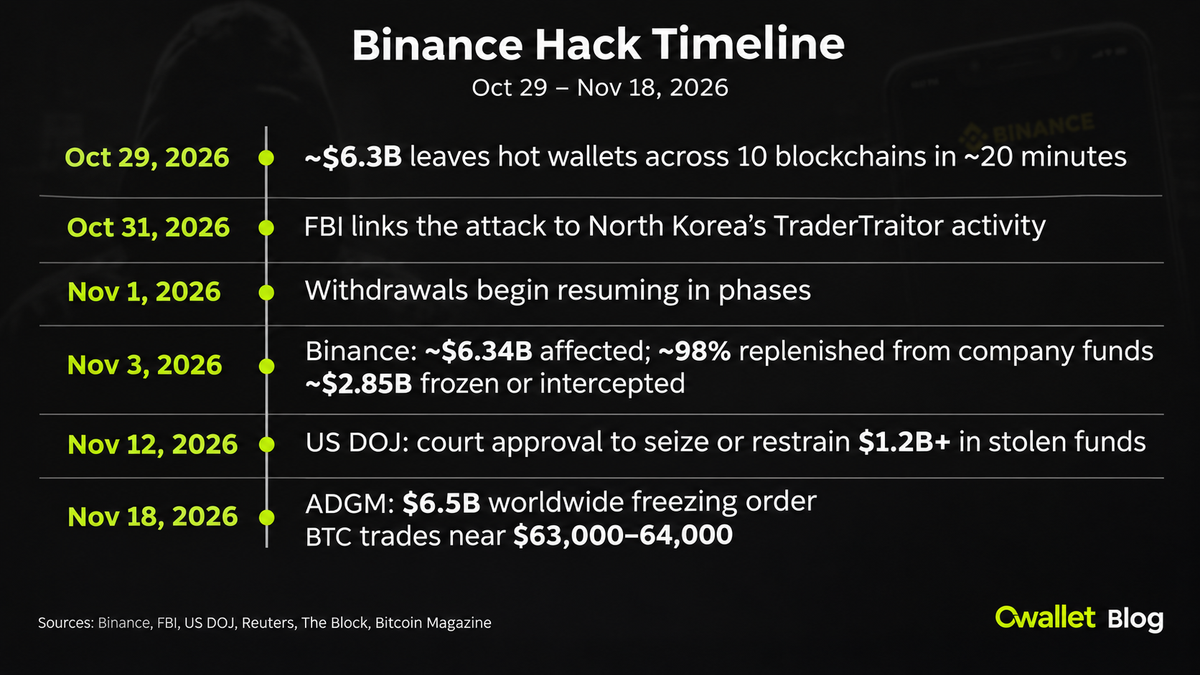
- October 29, 2026, from about 20:05 UTC: roughly $6.3–6.4 billion flowed out of Binance hot wallets in about 20 minutes, across 10 blockchains. Binance puts the figure at about $6.3 billion (about $6.34 billion in its November 3 preliminary findings); TRM Labs estimates about $6.36 billion and Elliptic about $6.43 billion.
- October 31, 2026: the FBI linked the attack to North Korea's TraderTraitor activity.
- November 1, 2026: Binance began restoring withdrawals in phases.
- November 3, 2026: Binance's preliminary findings said about $6.34 billion was affected, about 98% of affected assets had been topped up from company funds, and about $2.85 billion had been frozen or intercepted.
- November 12, 2026: the US Department of Justice said a court had authority over more than $1.2 billion of the stolen funds.
- November 18, 2026: Binance said a court in Abu Dhabi Global Market (ADGM) had granted a worldwide freezing order covering $6.5 billion. A freezing order stops the funds from being moved — it is not the same as money recovered.
For scale, the theft is about four times the roughly $1.46 billion Bybit lost in February 2025 (TRM Labs / Binance preliminary findings). Binance's full technical report on the root cause had not been published as of mid-November, so this is still an open investigation, not a closed case.
How Did the Hackers Get In Without Stealing a Private Key?
This is the part most coverage skips, and it is the part that matters for how you store crypto. A hot wallet is a wallet connected to the internet, so it can sign transactions quickly — that connection is also what makes it a target.
According to Binance's preliminary findings, the attackers spent months preparing: they used fake job interviews and a malicious coding assignment to infect an engineer's computer, spread through an internal AI tool to two more computers, and obtained a token used to deploy software containers. From there, they reached the internal wallet signing service — the system that approves transactions on behalf of the hot wallets.
On Ethereum, they used 50 EIP-7702 authorizations — a newer Ethereum feature that lets one account temporarily delegate its signing power to a piece of code, explained simply as giving a program a signed permission slip to act for you. Those authorizations were validly signed with Binance's own hot wallet keys, so the wallets carried out the attackers' contracts as if the instructions were legitimate. According to Binance's preliminary findings, no private key was stolen — the wallets were made to sign.
What Happened in the Market After the Hack?
The weeks after the theft were rough for crypto prices, though the hack was not the only driver — fading risk appetite, weak AI stocks, and shifting rate expectations also weighed on markets.
- Bitcoin traded near $63,000–64,000 on November 18–19, about 26% below its October high of roughly $87,200 and about 49% below its all-time high.
- US spot Bitcoin ETFs saw about $2.6 billion in net outflows in November.
- About $7.6 billion in bullish leveraged positions — bets that prices would rise, made with borrowed money — were liquidated after the hack.
- Market depth, a measure of how much can be bought or sold without moving the price, fell about 38% from its pre-hack high for the nearest 1% of buy and sell orders.
- Open interest in perpetual futures — the total value of outstanding futures contracts that never expire — stood near $41.6 billion, its lowest since November 2024.
There is another side to the story. CryptoQuant noted on November 18 that about 22,500 BTC left Binance on the day of the hack, but November 15–17 saw small net inflows. Withdrawals have resumed, and Binance says users are covered. What the incident showed is that the signing step can be an attack surface — which is why how you store crypto matters on whatever platform you use.
What This Means for How You Store Crypto
The hack targeted hot wallets, but that does not make cold wallets risk-free. A cold wallet is kept offline, so it is much harder to reach over the internet — yet it can still be lost, damaged, or set up badly, and the crypto on it can still be sent to the wrong address by its owner. In other words, no storage choice is risk-free; each one is a trade-off.
A hot wallet vs cold wallet comparison comes down to what you use it for: hot wallets are convenient for trading and everyday use but stay connected to the internet, while cold wallets suit long-term holding but are slower to use and cost money up front. If you are choosing a hardware wallet for cold storage, our Ledger vs Trezor comparison walks through the two best-known options.
A custodial wallet is a third option: a company holds the keys for you, so you do not manage a seed phrase, but you rely on that company's security instead of your own setup — Cwallet is a custodial wallet, and you can read how that works in our docs. And if you trade on a decentralized exchange (DEX) or a centralized exchange, the same rule applies: the exchange holds your funds while they sit there, so the amount you leave on any exchange deserves a thought.
What You Can Do Right Away
- Turn on two-factor authentication (2FA) on every exchange and wallet account that offers it, so a stolen password alone is not enough to get in.
- If your exchange or wallet offers a withdrawal allowlist, turn it on and add only addresses you control, so funds cannot be sent somewhere new without your approval.
- Do not click links in emails or messages about the hack, refunds, or "urgent security updates" — open the official site or app yourself instead.
- Never share your seed phrase or private key with anyone — no legitimate support team asks for them; if your account is custodial, like Cwallet, there is no seed phrase involved at all, so anyone asking for one is not from your wallet provider.
- Keep only what you trade with in a hot wallet or on an exchange, and move the rest to colder storage — our guide to hot and cold wallets explains how to split the two, and if you already have a wallet elsewhere, here is how to import an existing wallet.
FAQ: Staying Safe After the Binance Hack
Is my crypto on Cwallet affected by the Binance hack?
No — the attack targeted Binance's own hot wallets, and Cwallet accounts and funds are separate from Binance.
What is a freezing order, and does the $6.5 billion order mean the money is back?
A freezing order is a court order that stops the named funds from being moved; it covers up to $6.5 billion, but it is not the same as money recovered.
What should I do if I already clicked a suspicious link about the hack?
Stop, do not enter any password or seed phrase, and check your account through the official site or app — if you share any credentials, change your password and consider moving your funds to a new wallet.
Disclaimer: This content is for informational purposes only and does not constitute financial advice. Crypto assets are volatile, and all investment decisions should be based on your own research (DYOR). Cwallet assumes no liability for any losses.