Hot Wallet vs Cold Wallet: Is a Cold Wallet 100% Safe?
A hot wallet is connected to the internet, so it is easy to use but easier to attack. A cold wallet stays offline, so it is harder to hack — but it is not 100% safe either. The right choice depends on how you use your crypto: what you trade often, and what you plan to hold for a long time.
What Is a Hot Wallet?
A hot wallet is any crypto wallet that stays connected to the internet. It can be a phone app, a desktop program, a browser extension, or an account on a platform like an exchange or a custodial wallet service. Because it is online, you can send, receive, and trade in seconds, which is why most people start here.
Hot wallets come in two kinds. A custodial hot wallet means a company holds the keys for you — you log in with an account, much like logging in to a bank app. A non-custodial hot wallet means you hold the keys yourself, usually as a recovery phrase (a list of 12 or 24 words you keep private). If you are new to wallets, our guide to what a crypto wallet is explains both kinds in plain language.
The trade-off is simple: convenience comes with exposure. Anything connected to the internet can be reached by phishing links, fake apps, and malware on your device. In October 2026, about $6.3 billion was stolen from Binance's hot wallets (Binance's own figure) — the largest crypto theft reported so far — which is a reminder that even large platforms' hot wallets can be hit.
What Is a Cold Wallet?
A cold wallet is any crypto wallet that stays offline. The most common kind is a hardware wallet: a small physical device, a bit like a USB stick, that stores your keys and signs transactions without exposing them to the internet. Ledger and Trezor are the two best-known brands. A paper wallet — your keys printed on paper — is another form, though it is easy to lose or damage and hard to use.
Because a cold wallet is offline, an attacker on the internet cannot reach it directly. That is why people use cold wallets for savings they do not plan to touch for months or years. The trade-off is the opposite of a hot wallet: stronger protection, but slower and less convenient to use.
Hot Wallet vs Cold Wallet: What's Actually Different?
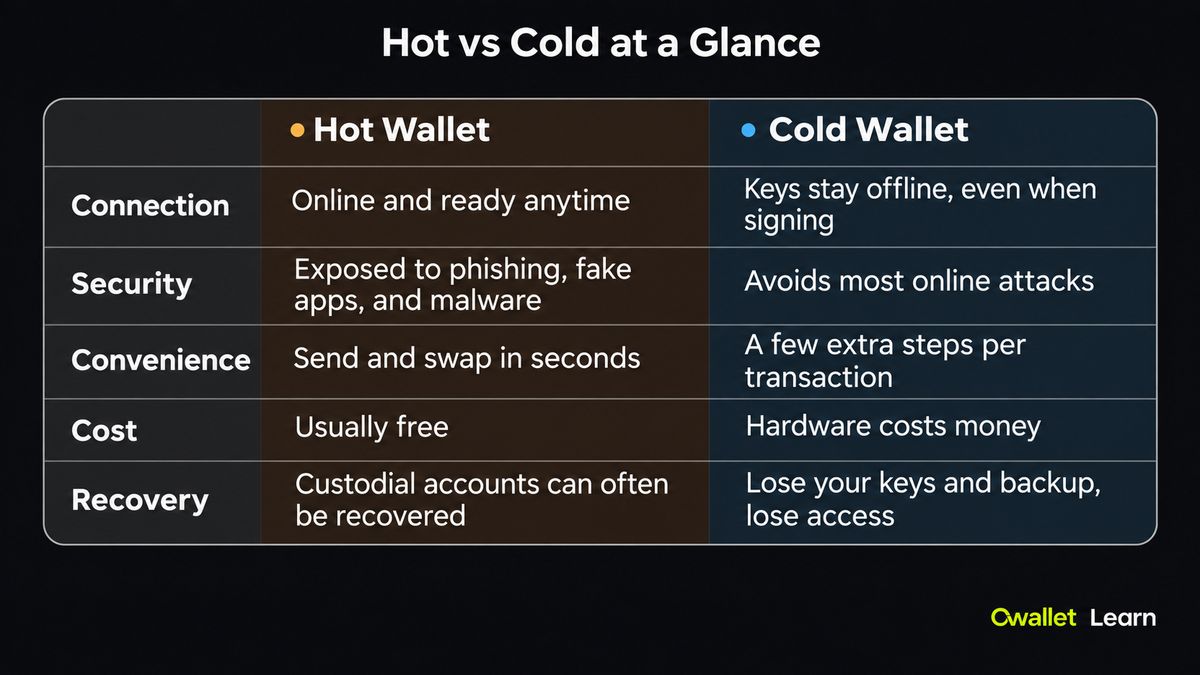
The difference comes down to five things:
- Connection. A hot wallet is online whenever you use it, so you can trade at any moment; a cold wallet stays offline and only connects briefly when you plug it in to sign a transaction.
- Security. A hot wallet faces online threats such as phishing, fake apps, and malware; a cold wallet avoids most of those because it is offline, though it can still be lost, damaged, or set up wrong.
- Convenience. A hot wallet lets you send and swap in seconds from your phone; a cold wallet takes a few extra steps each time, which is fine for long-term storage but annoying for daily use.
- Cost. Most hot wallets are free apps or accounts; a hardware wallet costs money to buy, usually tens to a couple of hundred dollars depending on the model, so check the current price before you buy.
- Recovery. If you lose access to a custodial hot wallet account, you can usually recover it with the platform's help; if you lose a cold wallet and its recovery phrase, the funds are usually out of reach.
What Is the Difference Between a Hardware Wallet and a Software Wallet?
A hardware wallet is a physical device that stores your keys offline, so it is one kind of cold wallet. A software wallet is an app or program — on your phone, computer, or browser — so it is usually a hot wallet, because it runs on a device that is online. The two ideas overlap but are not the same thing: "hardware vs software" is about the form (a device vs an app), while "cold vs hot" is about the connection (offline vs online). A hardware wallet can briefly connect to a computer to sign a transaction and still count as cold, because its keys stay on the device.
If you are comparing devices, our Ledger vs Trezor comparison walks through the two leading hardware wallets in detail.
Hot Wallet vs Cold Wallet: Which Is Safer?
For money you hold long-term, a cold wallet is the safer choice, because being offline removes the most common online attack paths. For money you trade with often, a hot wallet is the practical choice — a cold wallet would slow every trade down. Safety is not only about the wallet type, though.
A hot wallet with a strong password, two-factor authentication (2FA), and careful habits can be safer than a cold wallet whose recovery phrase is photographed and stored on a phone. In short: cold wins for storage, hot wins for everyday use, and your habits matter as much as the tool.
Is Cold Wallet 100% Safe?
No. A cold wallet removes online attacks, but it does not remove every risk. The recovery phrase is the weak point: if someone finds it, they can take the funds; if you lose it and the device breaks, the funds are usually out of reach. Devices can also be damaged, lost, or bought from an untrustworthy seller — a tampered device can be a trap, so buy hardware wallets only from the maker or an authorized seller.
And "cold" does not mean "unhackable": the moment you connect a hardware wallet to a compromised computer to sign, a fake screen or a swapped address can still trick you. Treat a cold wallet as much safer, not perfectly safe.
How to Use a Hot Wallet and a Cold Wallet Together
Most experienced users do not pick one or the other — they use both, for different jobs.
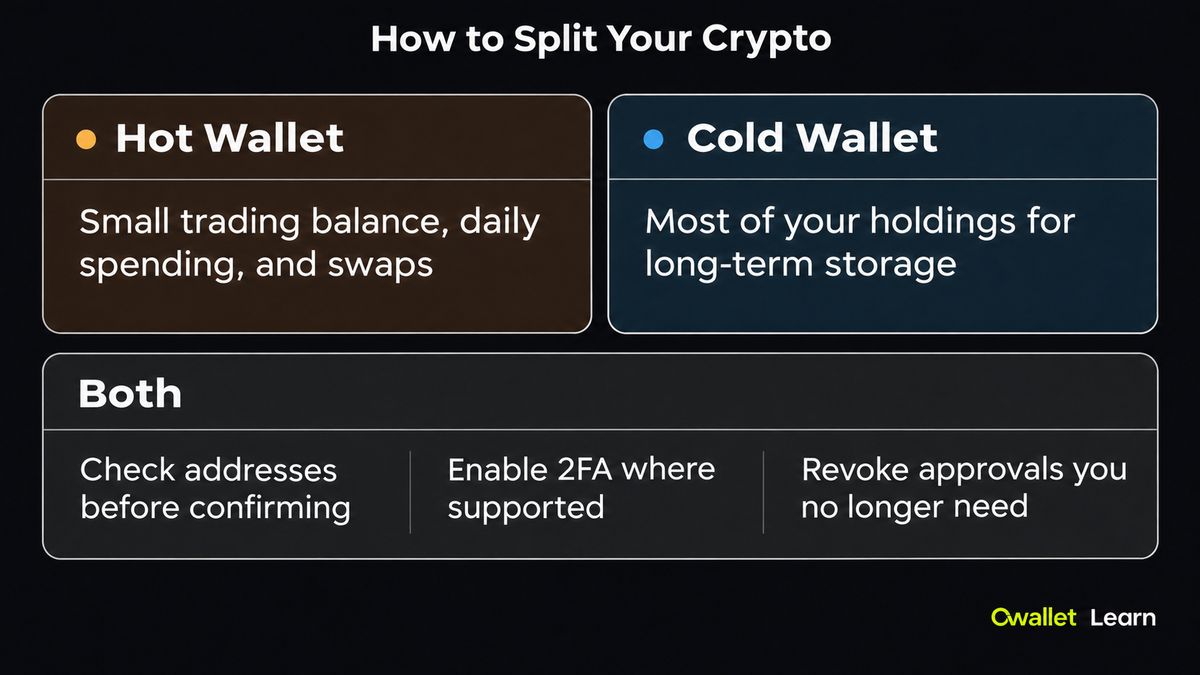
Keep a small amount in a hot wallet for trading on a decentralized exchange (DEX), swapping, and daily spending, and keep the bulk in a cold wallet for long-term holding. Move funds between them only when you need to, and check the address on the device screen before you confirm. If you use apps with the hot wallet, review what you have approved and revoke token approvals you no longer need, and turn on two-factor authentication (2FA) everywhere it is offered. The habit that matters most is the split itself: if the hot wallet is ever compromised, only the small trading balance is at risk.
Where Does Cwallet Fit?
Cwallet is a custodial wallet, which means it holds the keys for you and you access your funds by logging in to your account. In hot-vs-cold terms, that makes Cwallet a hot wallet: it is online, built for fast trading and everyday use. You can check the supported cryptocurrencies and swap between them inside the app. For long-term holdings, many users pair a custodial hot wallet like Cwallet with a cold wallet of their own, using the hot wallet for trading and the cold wallet for storage.

Common Questions About Hot Wallets and Cold Wallets
Do I need a cold wallet if I only hold a small amount of crypto?
No. For small, often-traded amounts, a hot wallet with a strong password and 2FA is enough — get a cold wallet once the amount is something you'd be upset to lose.
Can a software wallet ever be a cold wallet?
Yes — install it on a phone that never goes online, and the keys never touch the internet.
What should I do if I lose my hardware wallet?
Buy a replacement from the maker and restore it with your recovery phrase — your funds live on the blockchain, not on the device; without the phrase, they're usually gone.
What happens if I lose my seed phrase?
If you still have the wallet, move your funds to a new wallet right away; if you lost both, the funds are usually gone for good.
Do I lose my crypto if my phone breaks?
No. Restore the wallet with your recovery phrase on a new phone or any compatible wallet app
What if the hardware wallet company shuts down?
Nothing. Your funds live on the blockchain, and most hardware wallets share the same standard phrase format, so you can restore on another brand's device.
Disclaimer: The information in this article is for educational purposes only and does not constitute financial advice, investment advice, trading advice, or any other sort of advice. High-leverage trading involves substantial risk of loss and is not suitable for every investor. Please perform your own due diligence and never invest money that you cannot afford to lose.