What Are DApps? Decentralized Applications Explained With Examples
Most of us spend hours every day using apps like Instagram, Uber, or PayPal. One company controls the servers, your data, and the rules. Decentralized applications, or DApps, are the Web3 alternative — and this guide explains what they are, how they work, and which ones are worth knowing.
A DApp is an application whose core runs on a blockchain instead of a company's servers. You use it by connecting a crypto wallet — no account or password needed.
What Makes an App a DApp? 4 Signs to Check
For an application to count as a true DApp, it usually meets four criteria:
- Decentralized: its records and operations live on a public blockchain, so no single company or server controls it.
- Smart contract powered: self-executing contracts manage interactions without intermediaries.
- Open source: the code is usually public, so anyone can audit it for security and fairness.
- Incentivized: it often uses digital tokens to reward participants and secure the network.
How Does a DApp Work? No Servers, No Accounts
A DApp has three parts working together:
- Smart contracts: the logic of the app lives in code on a blockchain. When you take an action, the smart contract runs it exactly as written.
- Wallet connection: instead of creating an account, you connect a crypto wallet and sign transactions. Your wallet is your identity.
- On-chain and off-chain parts: some parts of a DApp live on-chain vs off-chain: core logic and asset ownership live on the blockchain, while the website you see in your browser may be hosted normally. That is why a DApp can keep working even if one website goes down, but also why you should only use websites you trust.
DApps vs Traditional Apps: What's Actually Different?
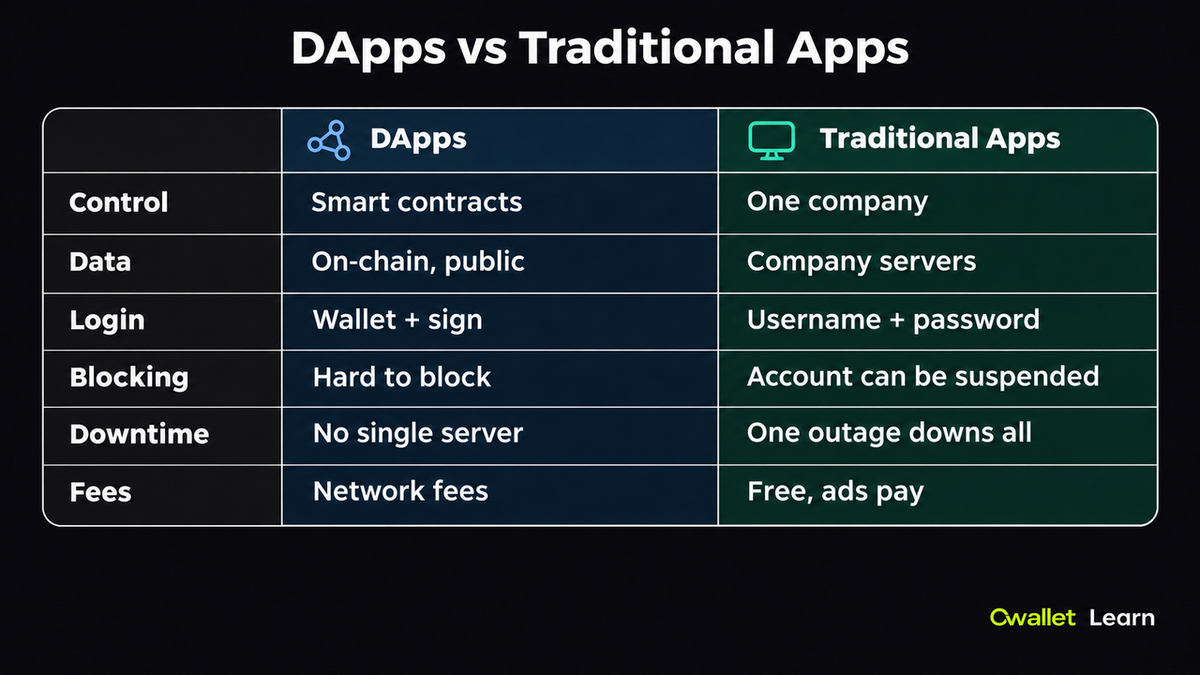
The biggest difference is control. A traditional app is owned by one company: it runs on the company's servers, stores your data there, and can suspend your account at any time. A DApp flips that around — its rules live in smart contracts on a public blockchain, so no single company controls it, and your data sits on the chain, visible to anyone.Logging in works differently, too. With a normal app you create a username and password. With a DApp you connect a crypto wallet and sign — there is no account to create and no password to forget.
That does not mean a DApp cannot be blocked. A smart contract is hard to shut down, but the website you use to reach it can still be taken down, and an app store can remove it. A traditional app is simpler to block: the company just suspends you.
Downtime follows the same pattern. A DApp has no single server to fail, though the website you use to reach it can still go down. A traditional app goes down with its company's servers.
And then there are fees. Most traditional apps are free to use — the company earns from ads or subscriptions. A DApp charges you network fees for every on-chain action.
What Are Examples of Decentralized Apps? 6 You Should Know
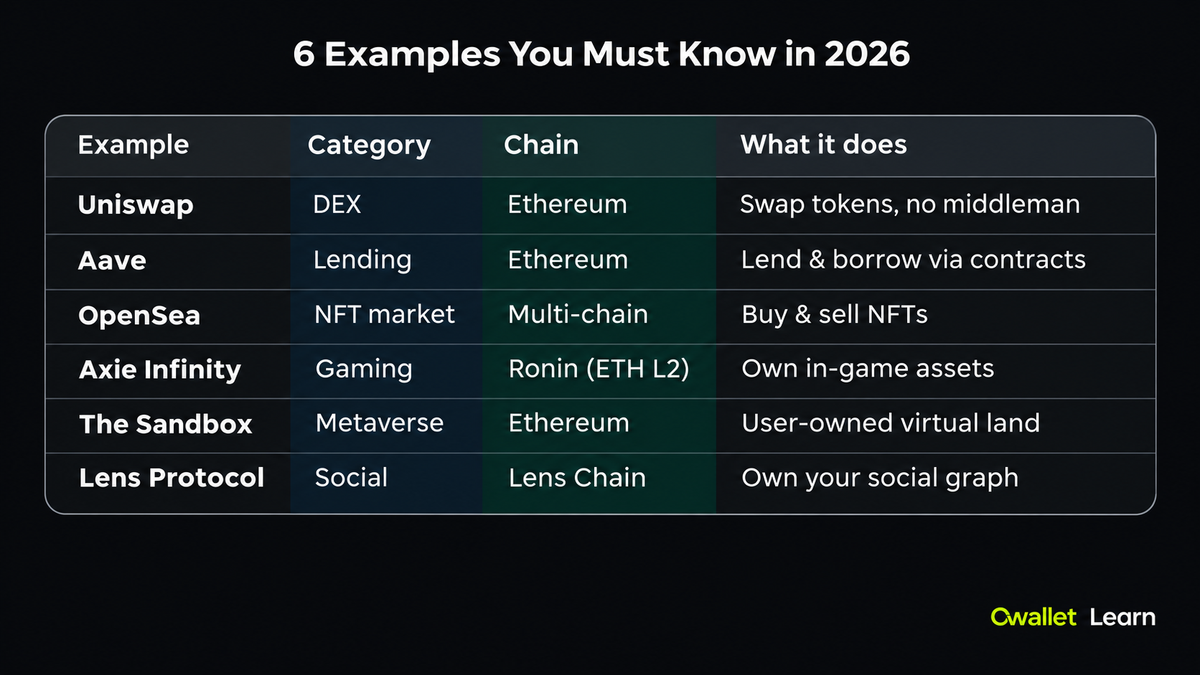
These six cover the main DApp categories — DeFi (decentralized finance), NFTs, gaming, and social:
- Uniswap is the largest DEX on Ethereum, letting anyone swap tokens directly from their wallet without a central intermediary.
- Aave is a DeFi lending protocol on Ethereum where users lend crypto to earn interest or borrow against their holdings, with every loan enforced by smart contracts.
- OpenSea is a multi-chain NFT marketplace where anyone can buy, sell, and discover digital collectibles and art.
- Axie Infinity is a blockchain game on Ronin (a gaming network built on Ethereum) where players own their in-game creatures and items as tokens and earn rewards by playing.
- The Sandbox is a metaverse world on Ethereum where players buy virtual land, build their own experiences, and trade user-owned items.
- Lens Protocolis a decentralized social protocol on Lens Chain that lets users own their social graph and carry their followers and content between apps.
Many DeFi apps also run on liquidity pools — shared reserves of tokens that let people trade without a middleman — and some are governed by DAOs, organizations run by their members' votes.
Which Crypto Apps Are Decentralized?
Crypto apps that run on smart contracts and public blockchains — such as DEXs, lending protocols, and NFT marketplaces — are decentralized. If an app holds your funds or your data on its own servers, it is not.How to tell whether an app is truly decentralized:
- It runs on smart contracts. The core rules are code on a public chain, not a private server.
- No company holds your funds. You keep control of your assets in your own wallet.
- Anyone can verify it. The contracts are public, and the rules cannot be changed in secret.
Why People Call DApps the Backbone of Web3
DApps are the tools that make the decentralized future real. Instead of a handful of companies running the apps everyone uses, the rules live in public code that anyone can check and build on. That is why DApps sit at the center of Web3: DeFi is building an alternative to banks, NFT marketplaces to galleries, blockchain games to app stores, and social DApps to platforms that can ban you without explanation. The shift is still early — using a DApp is often slower and harder than using a normal app — but more of the internet's core functions are getting a decentralized version.
DApp Advantages and Disadvantages: The Honest Trade-Off
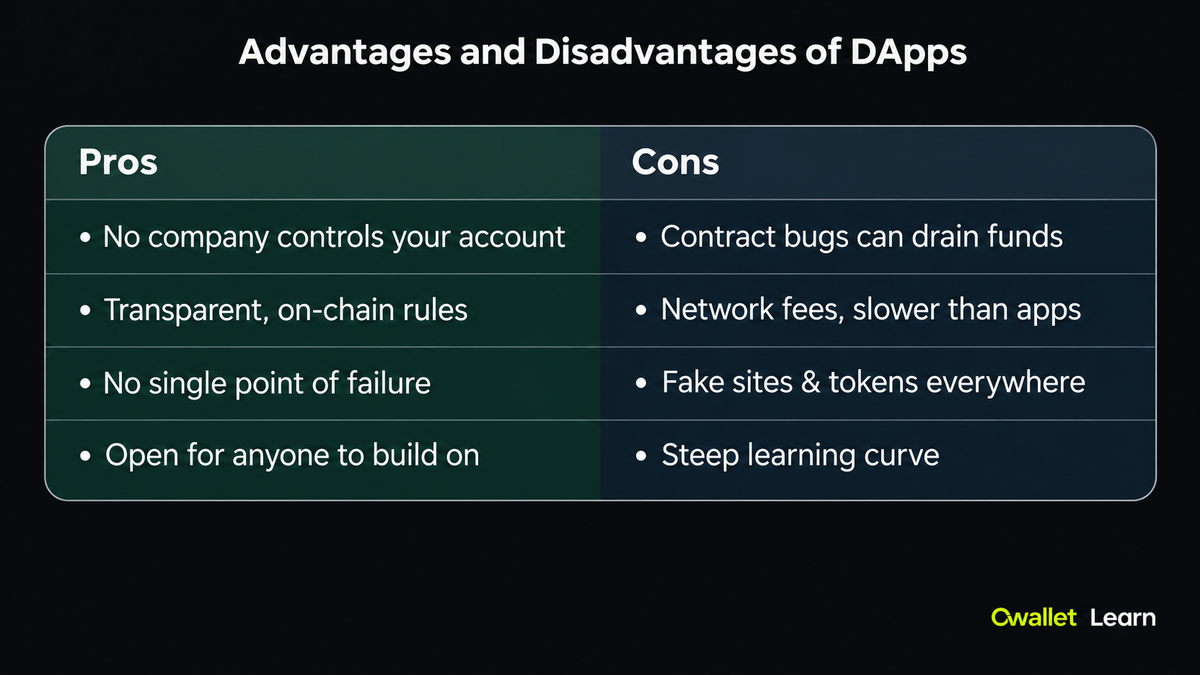
On the plus side, no single company controls your account or your funds, and the rules are transparent — anyone can check the rules on the blockchain. There is no single point of failure at the contract level, and because the protocols are open, anyone can build on top of them.
The trade-offs are real, though. Smart contract bugs can be exploited, and because transactions are usually irreversible, a mistake can cost you. You pay network fees for on-chain actions, and using a DApp is often slower than using a normal app. Fake front ends, fake tokens, and scams are common, and the whole experience is harder for beginners — wallets, network fees, and approvals take some getting used to.
DApps grew fast through 2025 — DappRadar's Q3 2025 report counted 18.7 million wallets using DApps each day — but 2026 has been a pullback. DeFi's total value locked (the money deposited in DeFi apps) was about $72 billion in mid-November 2026 (DefiLlama), down from roughly $145 billion a year earlier and far below the $237 billion record DappRadar reported in Q3 2025, shortly before it shut down. The risks, meanwhile, keep setting records: on October 29, 2026, attackers stole about $6.3 billion from Binance's hot wallets, the largest crypto theft in history — more than four times the $1.46 billion Bybit lost in February 2025.
The Risks Are Real: How to Use DApps Safely
- Verify contract addresses. Only interact with addresses published on the project's official site or docs.
- Use websites you trust. A malicious website can look identical to the real one.
- Revoke approvals you no longer need. After using a DApp, revoke token approvals so it cannot move your tokens later.
- Start small. Try a small amount first before moving larger sums.
- Turn on two-factor authentication (2FA) on every account that supports it, including your exchange and email.
Can You Use DApps With Cwallet?
Cwallet is a custodial wallet, not a DApp. Your assets are held in your Cwallet account, and you manage them after logging in — you do not connect Cwallet to a DApp the way you would with a self-custody wallet.Inside Cwallet, you can swap supported cryptocurrencies directly. To use a DApp itself, you need a self-custody wallet that connects to it.

Common Questions About DApps
What are examples of decentralized apps?
Uniswap (a DEX), Aave (lending), OpenSea (NFT marketplace), Axie Infinity (gaming), The Sandbox (metaverse), and Lens Protocol (social). See the examples table in this guide for details.
What crypto apps are decentralized?
Crypto apps that run on smart contracts and public blockchains — such as DEXs, lending protocols, and NFT marketplaces — are decentralized. If an app holds your funds or data on its own servers, it is not.
Can you provide a list of decentralized apps?
Yes — Uniswap, Aave, OpenSea, Axie Infinity, The Sandbox, and Lens Protocol. The examples table above lists each one's category, chain, and what it does.
Disclaimer: The information in this article is for educational purposes only and does not constitute financial advice, investment advice, trading advice, or any other sort of advice. High-leverage trading involves substantial risk of loss and is not suitable for every investor. Please perform your own due diligence and never invest money that you cannot afford to lose.