Perp Trading with Cwallet | How to Open Your First Order Step by Step
This guide walks you through the exact steps — from depositing into your account, to placing and managing a live perp order on Cwallet.

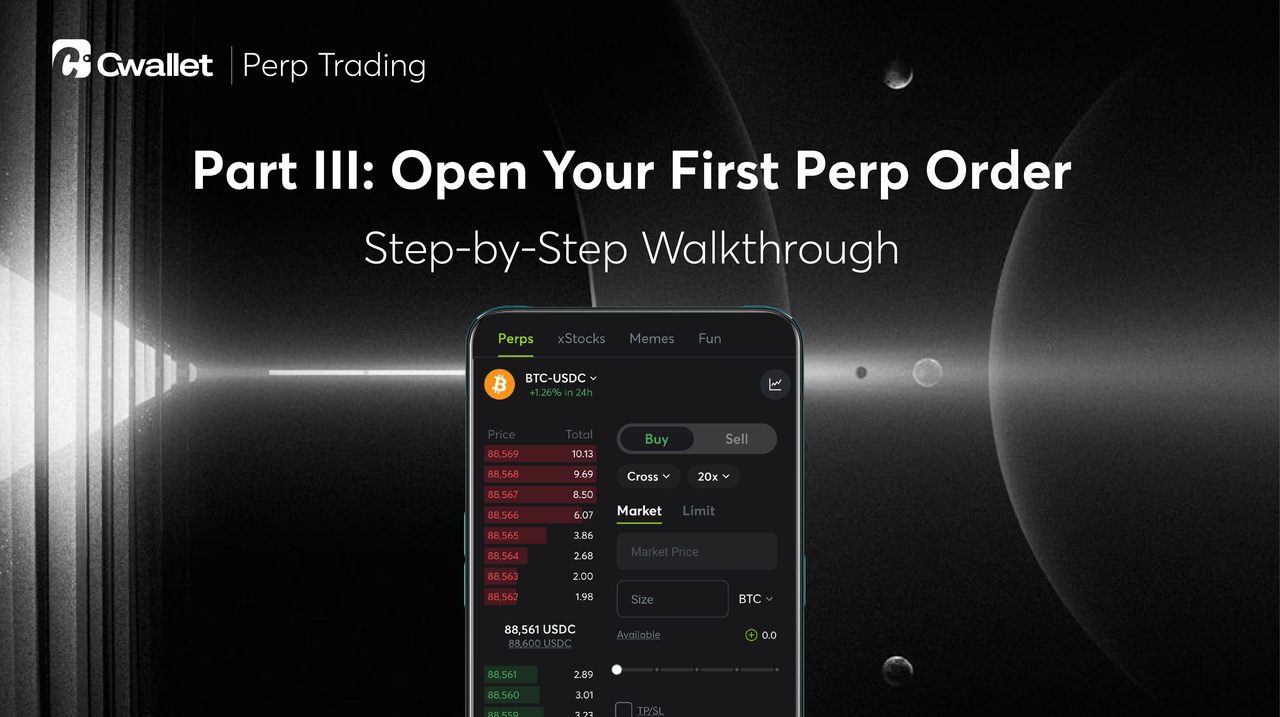
Opening your first perpetual futures position can feel intimidating.
This guide walks you through the exact steps — from depositing into your account, to placing and managing a live perp order on Cwallet. And we will explain the "why" behind each choice. Follow these steps slowly, use low leverage, and rely on Cwallet's built-in risk tools as you learn.
Before you begin (prerequisites)
Make sure you've done the basics:
- Deposit your account with fiat or crypto ($USDC is common collateral).
- Enabled 2FA and reviewed platform fees & disclaimers.
- Read the primer "Perp Trading with Cwallet" series of articles.
♻️ Referrals:
1️⃣ Perp Trading with Cwallet | What Are Perpetual Futures Contracts? A Beginner's Guide
2️⃣ Perp Trading with Cwallet | Crypto Trading Terms Every Beginner Must Know
With these basics in place, you're all set — let's walk through the exact steps to open your first perp trade on Cwallet.
1. Choose Trading Pair
Why: Picking the right market affects volatility, liquidity, and funding behavior.
How (on Cwallet):
- Open the Perpetual Futures section.
- Browse available markets (e.g., BTC/USDC, ETH/USDC, SOL/USDC).
- Select a pair with good liquidity (major tokens for first trades).
2. Deposit your Perps Account
Why: Perp positions require collateral (margin). Cwallet supports buying $USDC with fiat and instant swaps.
How:
- If you don't hold stablecoins, use Buy Crypto to purchase USDC with your local fiat.
- Or use Swap to convert an existing asset to USDC (Cwallet offers zero-fee swap for quick conversion).
- Transfer the needed amount into your Perp Account if the platform separates wallets.
💫 Tip: Start with a small amount you can afford to lose.
3. Set leverage and position size
Why: Leverage increases exposure and risk — the most important control for beginners.
How:
- Choose leverage (e.g., 2× to 5× recommended for first trades).
- Enter position size (Cwallet will calculate exposure).
- Review an estimated liquidation price shown in the UI.
💫 Safety: Keep leverage low if you're beginner.
4. Choose order type (Market / Limit)
Why: Order type controls how and when your trade executes.
Common types:
- Market Order: Executes instantly at current market price — use for immediate entry.
- Limit Order: Executes only at your specified price — useful to control entry price.
How (example):
- For beginners, a Limit order is often safer — it prevents slippage and gives control.
5. Add Stop Loss (SL) and Take Profit (TP)
Why: These protect capital and lock profits; essential discipline tools.
How:
- In the order UI, set Stop Loss (a price where position will close to limit further loss).
- Set Take Profit (a price to capture gains automatically).
💫 Note: Setting up SL/TP is strongly recommended to limit potential losses and protect your capital.
6. Review fees, funding rate & execution preview
Why: Fees and funding change net returns, especially for longer holds.
How:
- Check estimated maker/taker fee shown before you submit.
- View current funding rate (displayed on the pair page) and consider its effect if you hold overnight.
- Confirm estimated slippage and PnL preview on Cwallet.
7. Pick Long or Short to Open your Order
Why: Decide direction based on market view. Long = you expect prices to rise. Short = you expect price to fall.
How:
- Click Long or Short in the order panel for your chosen pair.
- Cwallet shows an immediate PnL preview so you can see potential outcomes.
💫 Tip: If unsure, paper-trade or set a very small position.
8. Adjusting and closing your positionHow:
- Adjust Leverage/Size: Some platforms allow reducing position size or adjusting leverage — check Cwallet tools.
- Close Position: Use "Close All" to exit the market or set a reverse order (eg. Use long order to close your sell order.)
💫 After trade: Record the outcome and reflect — what worked, what didn't? Keep a short trade journal.
⁉️ Practical tips & common beginner mistakes
- Ignoring funding rates for multi-day holds — funding can reduce profits.
- Using too much leverage — increases chance of liquidation.
- Not watching mark price — mark price triggers liquidation, not the last traded price.
- No SL/TP — emotional trading increases losses.
Perp trading uses leverage and carries high risk. Never stake money you can' afford to lose. Cwallet offers built-in security: account 2FA, clear order summaries, and real-time position alerts — use them.
Summary & Next Steps
Opening your first perp order is a step-by-step process: fund your account, choose a market, set low leverage, use SL/TP, and constantly monitor mark prices and funding rates. Cwallet's intuitive UI, order previews, and mobile alerts are designed to help beginners take these steps with confidence.
Next up in this series: “Perp Trading with Cwallet | Top 10 Common Beginner Mistakes in Markets”, where we break down real mistakes and how to avoid them.
Cwallet: Your Gateway to a New Era of Crypto Finance
Cwallet, more than a wallet, it's an all-in-one platform for secure crypto management and flexible trading.
Buy, swap, trade, earn, and spend 1,000+ cryptocurrencies across 60+ blockchains in one place. Spend your digital assets like cash with the Cozy Card, while tools like HR bulk management, mobile top-ups, and gift cards make everyday transactions smoother.
We are evolving into a comprehensive crypto finance hub. From Spot Trading, including Swap, Memecoins, and xStocks, to Futures Trading such as Perpetual Trading, 1001X, Trend Trade, and Market Battle, Cwallet supports different trading styles with clarity and control.
Plus, built-in IM keeps users connected with friends and informed directly within the trading experience.
Join millions reimagining what a crypto wallet can do. Stay cozy, trade smart, and explore the future of Web3 finance.
Official Link
Official Site: https://cwallet.com
Twitter: https://twitter.com/CwalletOfficial
Disclaimer
This content is strictly for informational and educational purposes only. It does not constitute financial, investment, legal, or tax advice, nor is it an offer or solicitation to buy, sell, or hold any digital asset. Crypto assets involve high volatility and risks, and their value can fluctuate greatly. Readers must be aware of and adhere to the relevant local laws and regulations concerning digital assets in their specific jurisdiction, as product availability may vary. All investment decisions must be based on your own research (DYOR) and risk assessment. Some content herein may be generated or assisted by artificial intelligence (AI) tools. The author and platform assume no liability for investment losses.