
Is Your Crypto Safe: Kelp DAO Hack Drags Aave into Systemic DeFi Crisis?
Is your DeFi safe? The $80M Kelp DAO exploit isn't just about one bridge. It's a chilling question for every Aave user and LST holder.

Key Takeaways
- A $292 million hack on Kelp DAO saw $80 million laundered through THORChain, but the attacker's use of Aave V3 to collateralize stolen rsETH exposes a new layer of systemic risk for the broader DeFi ecosystem.
- The incident highlights how a single exploit can create a contagion effect, potentially leading to bad debt on major lending protocols like Aave if the de-pegged rsETH collateral liquidates.
- For everyday traders and lenders, this underscores the urgent need to understand interconnected DeFi risks, diversify holdings, and use secure, multi-chain wallets to mitigate potential losses from cascading failures.
A $292 Million Wake-Up Call with a Systemic Twist
The crypto world is once again facing a major security challenge, but this time, the implications stretch far beyond a single protocol. The exploiter behind the $292 million Kelp DAO hack has not only begun laundering a significant portion of the stolen funds (approximately $80 million in Ethereum moved via THORChain) but has also introduced a chilling systemic risk by leveraging Aave V3.
For everyday users, this event highlights a critical tension in the decentralized finance (DeFi) space: the balance between censorship resistance, security, and the interconnectedness of financial primitives. While THORChain's design prioritizes neutrality, its use in such a high-profile money laundering operation raises questions about the broader implications for the crypto ecosystem. More critically, the attacker's interaction with Aave exposes how a single vulnerability can ripple through the entire DeFi landscape, potentially impacting even seemingly unaffected users.
What Happened: From Kelp DAO Exploit to Aave's Exposure
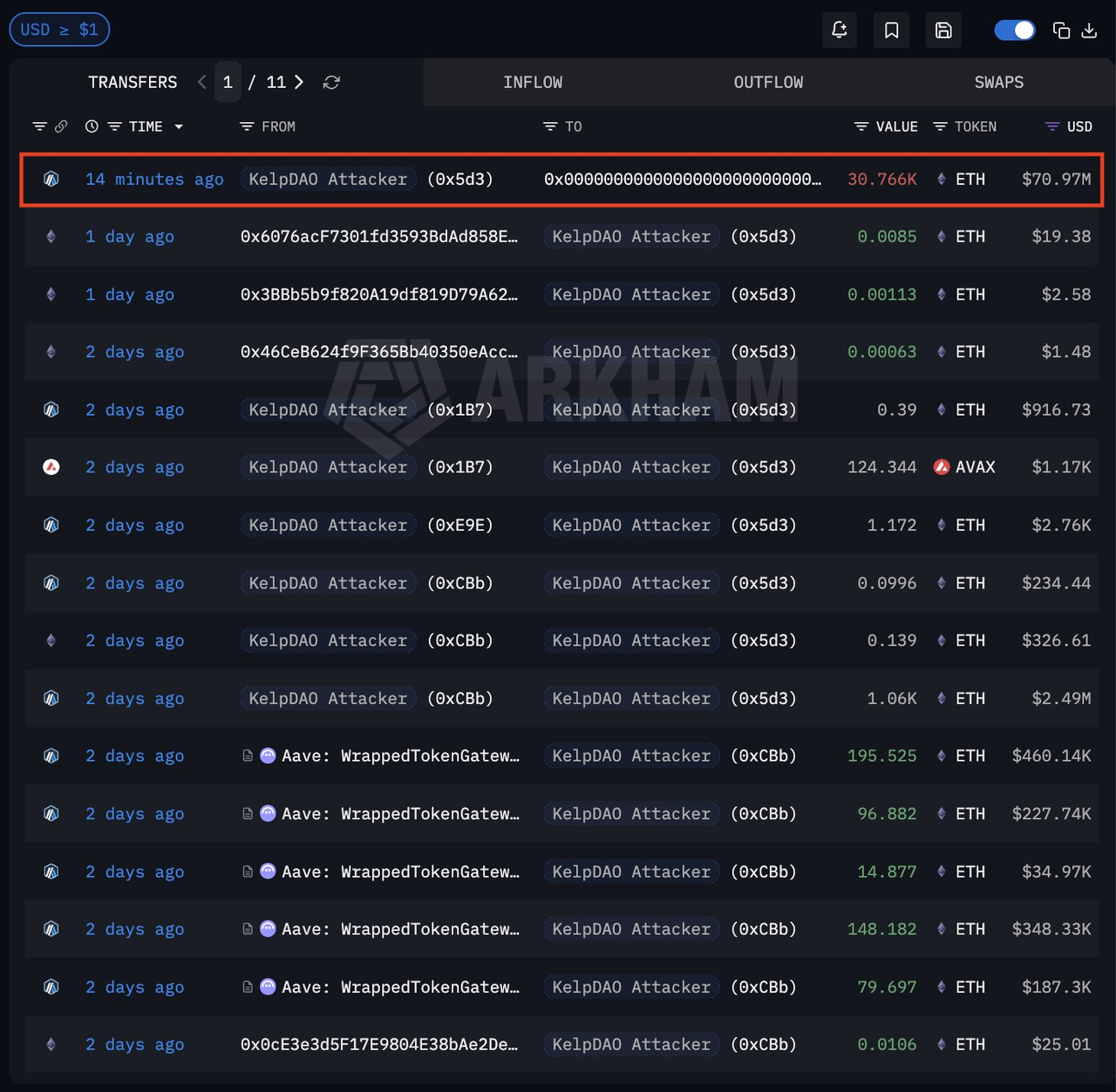
In a major security breach, the Kelp DAO, a LayerZero-powered cross-chain bridge, was exploited for a staggering $292 million. While Arbitrum's Security Council managed to freeze a portion of the stolen funds (around 30,766 ETH, valued at approximately $175 million), the attacker has since moved to launder the remaining assets.
Blockchain analysis firm EmberCN reported that the exploiter has already converted about 34,500 ETH into Bitcoin via THORChain. However, the more alarming development is the attacker's strategy involving Aave V3. The exploiter collateralized a significant portion of the stolen 116,500 rsETH (worth approximately $2.92 million) into Aave V3, borrowing roughly $2.36 million in wETH against it. This move effectively turned Aave into a mechanism for the attacker to extract more liquid assets, while leaving Aave potentially exposed to bad debt if the rsETH collateral de-pegs further.
Why This Matters: The Systemic Risk to DeFi
This incident is not just another hack; it's a stark illustration of systemic risk within the highly interconnected DeFi ecosystem. The attacker's move to deposit stolen rsETH into Aave V3 highlights several critical vulnerabilities:
- De-pegging Risk for rsETH: Kelp DAO's rsETH is a Liquid Staking Token (LST) that should ideally maintain a 1:1 peg with its underlying ETH. However, with 18% of Kelp DAO's mainnet reserves compromised, the rsETH is effectively unbacked. If the market loses confidence and rsETH de-pegs significantly, Aave could face substantial bad debt from loans collateralized by this now-risky asset.
- Contagion Effect: The rsETH is deployed across over 20 networks (Base, Arbitrum, Linea, Blast, Mantle, Scroll) via LayerZero's OFT standard. The mainnet treasury's compromise means that all wrapped rsETH on these L2s are now backed by an empty vault. A panic redemption on L2s could force Kelp to unstake from EigenLayer, which has withdrawal delays, creating a liquidity crunch and further de-pegging pressure.
- Aave as a Vulnerability Vector: The fact that a major lending protocol like Aave can be used to legitimize stolen, de-pegged assets raises serious questions about risk assessment and oracle reliance within DeFi. It exposes a potential flaw where the value of collateral is assumed without fully accounting for underlying protocol risks.
The Impact: What This Means for DeFi Lenders and LST Holders
The immediate impact of this event is multi-faceted. For THORChain, the protocol saw a significant increase in fee revenue, but it also drew renewed scrutiny. For the broader market, large-scale money laundering can create selling pressure.
However, the Aave connection introduces a more insidious threat:
- For Aave Lenders: If rsETH collateral on Aave V3 de-pegs severely, lenders who provided wETH could face losses if the value of the collateral drops below the liquidation threshold and cannot be fully recovered.
- For LST Holders: This incident is a wake-up call for all Liquid Staking Token holders. It demonstrates that the security of your LST is intrinsically linked to the underlying protocol's integrity and its cross-chain mechanisms. A hack on one component can compromise the entire LST ecosystem.
- Increased Regulatory Scrutiny: The use of decentralized protocols for money laundering, now compounded by the potential for systemic risk across major DeFi platforms, will undoubtedly intensify regulatory pressure on the entire crypto space.
What Crypto Users Should Do to Protect Their Digital Assets
In an environment where sophisticated attackers are constantly seeking vulnerabilities and exploits can ripple across the ecosystem, proactive security measures are paramount. Simply relying on the security of a single protocol is no longer enough. Users need to adopt a multi-layered approach to protect their digital assets.Here are a few practical steps:
- Diversify your holdings across different wallets, chains, and asset types to minimize single points of failure.
- Regularly audit the permissions granted to smart contracts and revoke any unnecessary approvals, especially for LSTs.
- Stay informed about recent exploits and understand the attack vectors to avoid similar pitfalls. Pay close attention to the health of LSTs you hold or use as collateral.
- Monitor your Aave positions closely if you are lending or borrowing, especially if your collateral includes LSTs or assets that could be affected by de-pegging events.
- Use hardware wallets for storing significant amounts of crypto, as they offer a higher level of security against online threats.
Where Cwallet Fits In: Enhancing Your Security in a Risky Landscape
In a world where even decentralized protocols can be exploited for illicit activities and systemic risks loom, having a reliable and secure wallet is more critical than ever. Cwallet is designed to provide users with the tools they need to navigate these complex and often risky waters.
Cwallet offers:
- Multi-chain asset tracking: Keep an eye on all your assets across various blockchains from a single, intuitive interface, making it easier to detect unusual activity and monitor the health of your LSTs.
- Secure swap functionality: Execute cross-chain swaps with confidence, knowing that your transactions are processed through robust and audited systems, reducing exposure to risky bridges.
By providing a comprehensive and secure platform, Cwallet empowers users to manage their digital assets with greater peace of mind, even when the broader crypto ecosystem faces security challenges and systemic risks.
Conclusion
The Kelp DAO exploit, its subsequent laundering through THORChain, and the alarming connection to Aave V3 serve as a stark reminder of the ongoing security challenges and the inherent systemic risks within the DeFi space. While the principles of decentralization and censorship resistance are fundamental, they also present complex dilemmas when confronted with illicit activities and interconnected vulnerabilities.
For users, this event underscores the critical importance of heightened security awareness, proactive asset management, and a deep understanding of the protocols they interact with. As the crypto landscape continues to evolve, understanding these systemic risks and utilizing robust tools will be key to protecting your investments. The debate between absolute decentralization and necessary safeguards will continue, but for now, staying informed and secure remains the best defense against cascading failures in DeFi.
Cwallet: Your Gateway to a New Era of Crypto Finance
Cwallet allows you to store, trade, and manage 1,000+ cryptocurrencies across 60+ blockchains, offering flexibility for both Spot Trading and Futures Trading. With features like Perpetual Trading, Cozy Card, and more, Cwallet empowers you to make the most of your crypto journey.
Join the Community & Earn More
Trade daily, earn more. Cwallet's Telegram and Discord communities host regular trading challenges across Market Battle, Trend Trade, 1001X, and Tap Grid, with extra rewards waiting for active participants.
👉 Join us on Telegram or Discord to participate in ongoing events and claim your rewards.
Official Links
Official Site: https://cwallet.com
X: https://x.com/CwalletOfficial
Disclaimer
This content is for informational purposes only and does not constitute financial advice. Crypto assets are volatile, and all investment decisions should be based on your own research (DYOR). Cwallet assumes no liability for any losses.