From OpenClaw to ERC-8183: Are AI Agents Becoming the Next On-Chain Economy?
AI agents are evolving beyond chat tools, with platforms like OpenClaw demonstrating how autonomous systems can execute tasks across digital environments.


Key Takeaways
- AI agents are evolving beyond chat tools, with platforms like OpenClaw demonstrating how autonomous systems can execute tasks across digital environments.
- ERC-8183 proposes a framework for AI-to-AI transactions on Ethereum, potentially enabling structured payments and verifiable service agreements between agents.
- The convergence of AI automation and blockchain infrastructure is giving rise to a potential “AI agent economy,” where autonomous systems can work, transact, and coordinate on-chain.
For most of the past two years, artificial intelligence in crypto has largely meant smarter tools: chatbots, analytics dashboards, and automated trading assistants. But a new wave of developments suggests something more ambitious is beginning to take shape.
Projects like OpenClaw are experimenting with AI agents that can execute complex tasks across the internet, while Ethereum developers are proposing standards such as ERC-8183 to support structured economic interactions between those agents.
Taken together, these signals point toward a larger shift: AI agents may soon move beyond assisting humans and begin participating in their own digital economy on-chain.
Why AI Agents Are Suddenly Everywhere
The concept of an AI agent refers to software capable of performing actions autonomously. Instead of simply answering questions, agents can plan tasks, call external tools, interact with APIs, and complete workflows with minimal human input.
Recent advances in large language models have dramatically improved agent capabilities. As a result, developers are experimenting with AI systems that can:
- Execute automated research and analysis
- Interact with websites or software tools
- Coordinate tasks across multiple services
- Manage digital assets or perform on-chain transactions
This shift has sparked growing interest in what some analysts call the AI agent economy. In such a system, agents may not only perform tasks but also exchange services, data, or digital assets with each other.
For that vision to work, however, AI systems need infrastructure that enables trust, payment, and verification.
That is where both OpenClaw and ERC-8183 enter the conversation.
What OpenClaw Shows About the Future of Automation
OpenClaw has recently attracted attention in developer communities for experimenting with AI agents capable of interacting with real online environments.
Rather than operating purely within a chat interface, these agents can perform sequences of actions across platforms and tools, effectively acting as autonomous digital workers.
In practice, this could enable scenarios such as:
- AI agents gathering data from multiple sources
- Executing complex workflows across different applications
- Performing automated operational tasks for businesses or individuals
While still experimental, platforms like OpenClaw demonstrate how quickly AI agents are evolving from passive assistants into active operators within digital systems.
But as soon as agents begin completing real tasks, an important question emerges:
How do they get paid?
And equally important:
How do participants verify that a task was completed correctly?

Why ERC-8183 Matters for AI Commerce
This is where ERC-8183, a proposed Ethereum token standard, becomes relevant.
The goal of ERC-8183 is to create a framework that allows structured economic interactions between agents on-chain. Instead of relying on informal agreements or centralized coordination, the standard introduces a more programmable model for service transactions.
In simplified terms, the structure involves three roles:
- Client – the entity requesting a task
- Provider – the AI agent performing the task
- Evaluator – a mechanism or agent verifying the result
Funds can be placed in escrow, and once the evaluator confirms the task outcome, the payment is released. This structure mirrors real-world service contracts but is executed through smart contracts on Ethereum.
If adopted widely, ERC-8183 could provide a standardized mechanism for AI-to-AI commerce, enabling agents to:
- Accept tasks
- complete work
- receive on-chain payments
- build verifiable reputations
Such infrastructure could be a foundational layer for a future agent-driven marketplace.

Could Ethereum Become the Settlement Layer for AI Agents?
The convergence of autonomous agents and blockchain infrastructure raises a compelling possibility: that Ethereum and other smart contract platforms may become settlement layers for AI activity.
Blockchains already provide features that align well with the needs of autonomous systems:
- Programmable payments through smart contracts
- Transparent transaction records
- Trustless escrow and settlement mechanisms
- Global accessibility without centralized intermediaries
If AI agents begin transacting frequently with one another, they will require a neutral infrastructure capable of managing assets, payments, and agreements.
Crypto networks are uniquely positioned to fulfill that role.
While the idea of a fully autonomous AI economy remains speculative, the early building blocks are clearly emerging across both AI development and blockchain standards.

Where Platforms Like Cwallet Fit In
As new forms of digital interaction emerge, infrastructure that manages assets and transactions will play an increasingly important role.
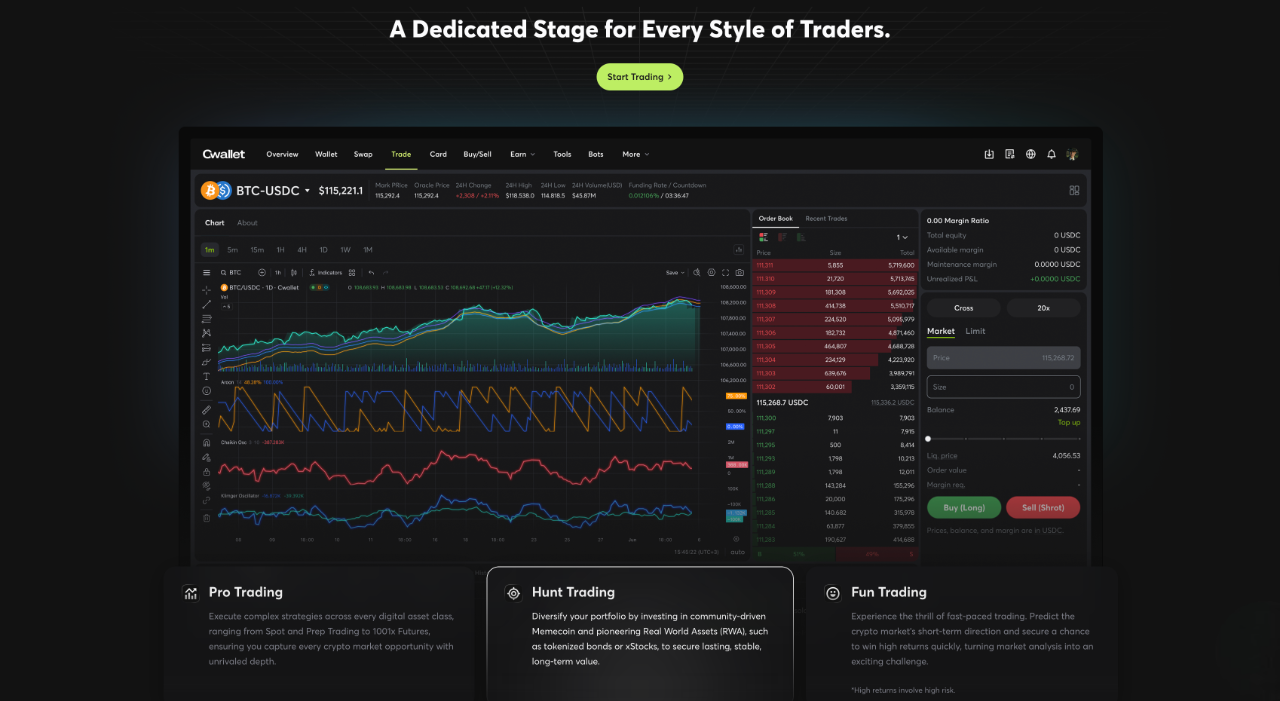
Platforms like Cwallet, designed as a multi-asset Web3 hub, help bridge the gap between users, applications, and blockchain networks. By supporting secure asset management, on-chain transfers, and cross-ecosystem connectivity, such platforms provide the financial infrastructure that complex digital ecosystems depend on.
If AI-driven services and agent-based transactions continue to expand, tools that simplify asset management and enable seamless on-chain activity will become even more important for both users and developers.
Conclusion
The rapid rise of AI agents is already reshaping how software interacts with the internet. With projects like OpenClaw exploring autonomous workflows and standards such as ERC-8183 proposing new economic frameworks, the next phase of development may involve agents participating directly in digital markets.
While the concept of an AI-powered on-chain economy is still in its early stages, the pieces are beginning to fall into place.
If these trends continue, the question may no longer be whether AI agents will operate within blockchain ecosystems, but how large their economic footprint could eventually become.
Cwallet: Your Secure, All-in-One Gateway to Global Crypto Finance
Cwallet redefines the digital wallet, offering a unified, high-performance platform to manage your entire portfolio, supporting over 1,000 cryptocurrencies across 60+ global networks. We combine top-tier security with unmatched utility.
Financial Control: Go beyond holding. Engage in Spot Trading, including Swap, Memecoins, and xStocks, or explore Futures Trading, such as Perpetual Trading, 1001X, Trend Trade, and Market Battle, for dynamic market action.
Real-World Power: Instantly unlock the spending potential of your assets. The Cozy Card transforms your crypto into a flexible payment solution for secure, real-world transactions online and offline.
Practical Tools: Boost efficiency with integrated services. Use HR Bulk Management for business needs, or Gift Cards and Mobile Top-ups for everyday utility.
Cwallet is where security, utility, and innovation come together in one powerful application.
Join millions transforming the way they manage their digital wealth.
Join the Community & Earn More
Trade daily, earn more. Cwallet's Telegram and Discord communities host regular trading challenges across Market Battle, Trend Trade, 1001X, and Tap Grid, with extra rewards waiting for active participants.
👉 Join us on Telegram or Discord to participate in ongoing events and claim your rewards.
Official Link
Official Site: https://cwallet.com
X: https://x.com/CwalletOfficial
Disclaimer
This content is strictly for informational and educational purposes only. It does not constitute financial, investment, legal, or tax advice, nor is it an offer or solicitation to buy, sell, or hold any digital asset. Crypto assets involve high volatility and risks, and their value can fluctuate greatly. Readers must be aware of and adhere to the relevant local laws and regulations concerning digital assets in their specific jurisdiction, as product availability may vary. All investment decisions must be based on your own research (DYOR) and risk assessment. Some content herein may be generated or assisted by artificial intelligence (AI) tools. The author and platform assume no liability for investment losses.