What Is a CEX and DEX in Crypto? Understanding the Difference
For many beginners, buying or trading crypto seems straightforward. Open an app, choose a coin, and place an order.
But behind that simple experience, crypto trading actually operates through two very different systems: Centralized Exchanges (CEXs) and Decentralized Exchanges (DEXs).
Both allow users to trade cryptocurrencies, but they work in completely different ways.
One relies on a company to manage assets and transactions.
The other allows users to trade directly from their own wallets without intermediaries.
Understanding this difference is important because it affects:
- How assets are stored
- Who controls the funds
- How trades are executed
- The balance between convenience and self-custody
What Is a Centralized Exchange (CEX)?
A Centralized Exchange (CEX) is a crypto trading service operated by a company or organization.
Popular examples include Coinbase, Binance, and Kraken.
When using a CEX:
- Users create an account
- Funds are deposited onto the platform
- The exchange manages custody and executes trades internally
This model is similar to how traditional financial platforms operate. Because the platform controls the infrastructure, CEXs are often designed to be beginner-friendly and fast to use.
Common Features of CEXs
- Simple user interfaces
- Fiat currency support
- Faster trade execution
- Customer support and account recovery
- Advanced trading tools such as futures or margin trading
However, using a CEX also means trusting the platform to hold and secure assets on behalf of users.
This is why the phrase “Not your keys, not your coins” is commonly discussed in crypto communities.
What Is a Decentralized Exchange (DEX)?
A Decentralized Exchange (DEX) allows users to trade crypto directly from their own wallets using blockchain-based smart contracts.
Unlike a CEX, a DEX does not require users to hand over custody of their assets to a centralized company.
Popular DEXs include Uniswap and PancakeSwap.
When using a DEX:
- Traders connect a crypto wallet
- Trades are executed on-chain through smart contracts
- Users maintain direct control of their funds
This model reflects one of crypto’s original ideas: peer-to-peer financial interaction without intermediaries.
Common Features of DEXs
- Self-custody of assets
- Wallet-to-wallet trading
- Permissionless access
- Greater transparency through on-chain transactions
- Access to newer or emerging tokens
At the same time, DEXs may feel more complex for beginners, especially when interacting with gas fees, wallet approvals, or blockchain networks.
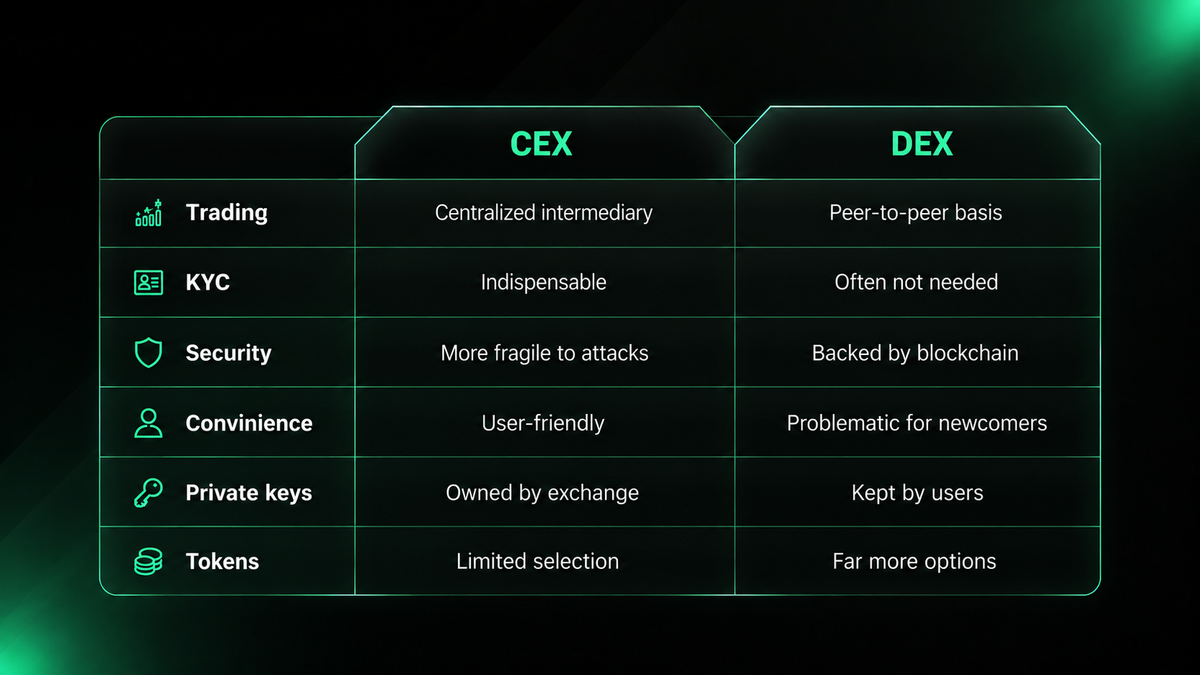
CEX vs DEX: What's the Main Difference?
The biggest difference comes down to custody and control.
In a CEX:
- The platform holds assets for users
- Trading happens within the exchange system
- Convenience and speed are prioritized
In a DEX:
- Users control their own wallets and private keys
- Trades happen directly on the blockchain
- Self-custody and decentralization are prioritized
Neither model is universally “better.” They simply serve different needs and user preferences.
Many crypto users eventually use both depending on the situation.
Why Both Models Exist in Crypto
Crypto has grown far beyond a single type of trading experience.
Some users prioritize:
- Simplicity
- Fiat onboarding
- Customer support
- Faster execution
Others prioritize:
- Self-custody
- Transparency
- Decentralization
- Direct wallet interaction
This is why both CEXs and DEXs continue to play important roles in the crypto ecosystem.
As the industry evolves, many platforms and Web3 services are also beginning to combine elements of both experiences.
Why Many Beginners Start With CEXs
For many users, centralized exchanges are the first step into crypto.
Features like:
- fiat currency purchases
- simplified trading interfaces
- customer support
- easier account management
make CEXs more approachable for beginners compared to fully decentralized environments.
This is one reason why centralized platforms continue to play an important role in crypto adoption, especially for users who are still learning how wallets, blockchain networks, and on-chain transactions work.
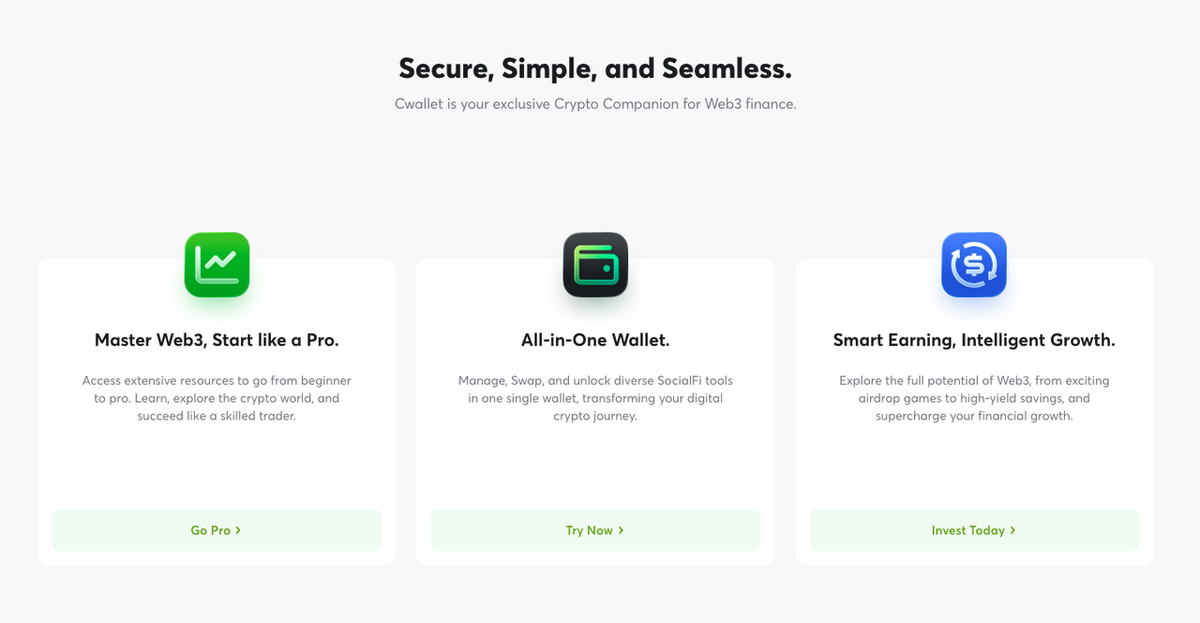
Within a Web3 hub like Cwallet, users can access crypto trading and market features through a more beginner-friendly experience while gradually becoming familiar with broader crypto concepts and trading models.
As users gain more experience, understanding how centralized and decentralized systems differ becomes increasingly important for navigating the wider Web3 ecosystem.
Before moving forward, let's do a quick review.
Quick Check-in
1. What is the main characteristic of a CEX?A) Users always control private keysB) A company manages trading and custody ✅C) All trades happen on-chain
2. What makes a DEX different?A) Trades occur directly through smart contracts ✅B) No wallet is neededC) Assets are stored by a central company
3. Why do some users prefer DEXs?A) They remove all trading riskB) They allow direct control of assets and wallets ✅C) They eliminate blockchain fees
CEXs and DEXs represent two different approaches to crypto trading and asset management.
One focuses on convenience and managed infrastructure. The other emphasizes self-custody and decentralized interaction.
As crypto continues to evolve, understanding how these systems work helps users make more informed decisions about where assets are stored, how trades are executed, and what level of control they want over their digital assets.
Disclaimer: The information in this article is for educational purposes only and does not constitute financial advice, investment advice, trading advice, or any other sort of advice. High-leverage trading involves substantial risk of loss and is not suitable for every investor. Please perform your own due diligence and never invest money that you cannot afford to lose.